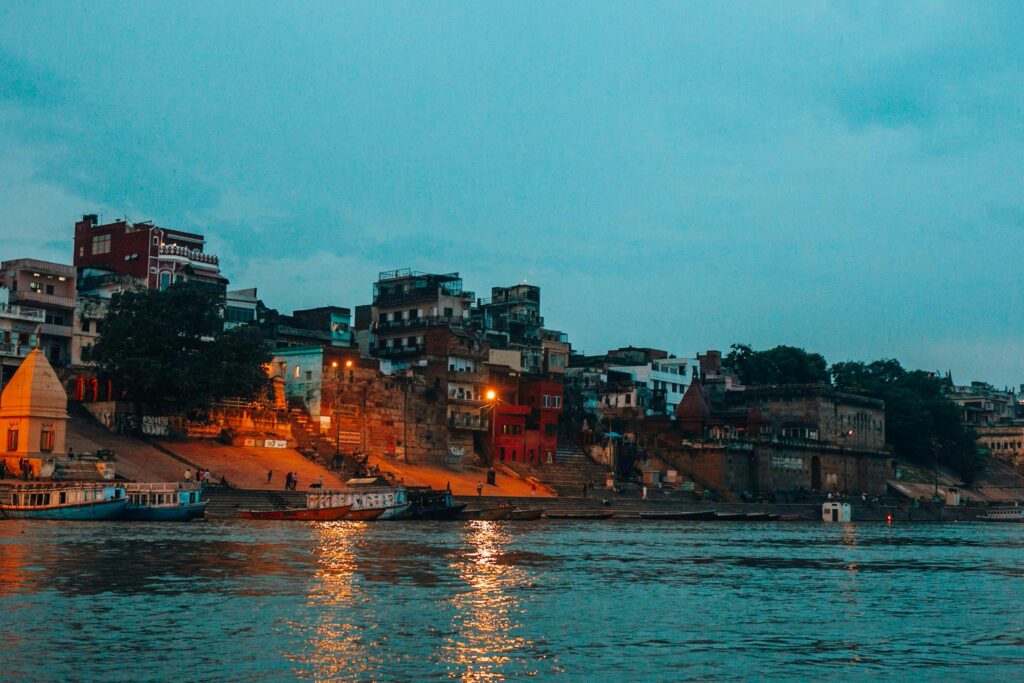
The Ganges River flowing through Varanasi is more than a riverbank setting—it is the stage of one of humanity’s oldest living civilizations, where history has never paused, only evolved. Archeological and literary evidence place Varanasi’s origins as far back as the 2nd millennium BCE, making it one of the world’s longest continuously inhabited cities. It rose early as a powerful center of Vedic religion and philosophical thought, attracting scholars, seekers, and traders alike.
By the 6th century BCE, Varanasi had become the capital of the ancient Kashi, a region renowned for prosperity and intellectual depth. Around the same time, just a few kilometers away at Sarnath, Gautama Buddha delivered his first sermon, introducing the concept of the “Middle Path,” which would go on to influence millions across continents. This firmly positioned Varanasi not only as a Hindu spiritual nucleus but also as a cornerstone in the rise of Buddhism.
Historically, the city was also a thriving economic hub. Ancient texts and foreign accounts highlight its excellence in silk weaving (especially the famed Banarasi silk), muslin textiles, perfumes, ivory carving, and metal craftsmanship—industries that connected Varanasi to trade routes across Asia. The observations of Xuanzang in the 7th century CE further confirm its prominence; he described a densely populated, culturally rich city stretching about 5 km along the Ganges, filled with temples, learning centers, and active marketplaces.
What truly elevates Varanasi beyond history is its uninterrupted continuity. Despite invasions, political shifts, and modernization, the city has retained its core identity. The ghats lining the Ganges—used daily for rituals, learning, and life-cycle ceremonies—represent traditions that have been practiced for thousands of years without break.
Varanasi is not just ancient—it is timeless. It stands as a rare example where spirituality, commerce, education, and daily life have coexisted for millennia, making it not merely a city but a living legacy of human civilization.
The history of Varanasi, like many ancient cities, reflects cycles of disruption and revival, yet its spirit has remained remarkably resilient.
A significant turning point came in 1194, following the invasion of Qutb-ud-din Aibak under the command of Muhammad of Ghor. This marked the beginning of a prolonged period of political upheaval under the Delhi Sultanate, during which many temples were destroyed and a number of scholars and spiritual leaders migrated elsewhere. This led to a temporary decline in Varanasi’s prominence as a major center of learning and ritual life.
However, the city’s revival began during the reign of Akbar in the 16th century. Known for his relatively inclusive policies, Akbar encouraged religious tolerance and supported the reconstruction of temples and institutions, allowing Varanasi to regain some of its lost cultural vitality. This period saw the return of scholars and the re-establishment of intellectual traditions.
The stability did not fully endure. During the rule of Aurangzeb in the late 17th century, several prominent temples were again destroyed or converted, reflecting a shift in imperial policy. Despite these challenges, Varanasi’s deeply rooted spiritual significance ensured that its religious practices continued, often adapting quietly rather than disappearing.
A major resurgence came in the 18th century under the patronage of the Maratha Empire. The Marathas actively supported the rebuilding of temples, ghats, and religious institutions, playing a crucial role in restoring Varanasi’s sacred landscape. Many of the prominent ghats seen today owe their structure to this period of revival.
By the late 18th century, Varanasi evolved into an independent principality before gradually coming under British East India Company influence. Under British rule, while political control shifted, the city continued to flourish as a major commercial hub—especially for silk and handicrafts—and remained one of India’s most important religious centers.
What stands out across these centuries is not just the rise and fall of power, but the continuity of faith and culture. Varanasi endured invasions, policy shifts, and colonial rule, yet it never lost its identity—emerging each time with renewed strength, reaffirming its place as one of the world’s most enduring living cities.